
Zero Waste thinking has not had a densely full history but there have been a number of seminal works that developed the thoughts in many important ways. This page presents some of the central works from which current thinking evolved.
Not only that, I think these links are interesting and stimulating. Try a few at random.
The Devastating Consequences of the Failure to Adopt New Designs When Encountered
An extract from the book 1491 by Charles Mann.
2007
Before beginning this review, you should click over to Mann’s discussion and read it.
Mann’s book, and its companion 1493, are incisive, analytical, historical, journalistic, deep and fascinating. 1491 traces the population history of the Americas before Columbus ever showed up in 1492.
In this extract, he muses over the consequences of early American civilizations’ failing to apply wheels to vehicles, grinding, pottery making and taking energy from falling water. As he ponders, he makes an unfortunate and implicit assumption, one which the history of Zero Waste shows is untenable. He assumes that if one person over two thousand years had just realized that a wheel could be used to transport goods more efficiently, the entire culture would instantly have adopted the innovation and we would be digging up remains of wheels all over the place. I wonder what he thinks is the experimental basis for this innovation. We don’t know, since he just makes this assumption without offering to justify it.
The history of garbage creation is a perfect analogue to the history of transporting goods. Today we see that this way of destroying resources has a life of its own. Virtually every member of our advanced society accepts it as a divine given. Try to argue that there is a better way and you will be told that there cannot be a better way, there will never be a better way and anyone who thinks we could find a better way is a radical, alien thinker who cannot be trusted. Although Zero Waste Theory is fully worked out and applied, there is a monumental resistance, even by ordinary people, to anything more mentally challenging than the lazy reliance on recycling.
I was much impressed by the report in Low Impact Man that the family who tried to cut down a significant part of their garbage generation had to deal with death threats (see review of Low Impact Man below).
I would therefore offer Mr. Mann an alternative explanation for the reason why the Mesoamerican cultures had no wheels. My guess is that thousands of people over centuries had the idea of using rolling motion but that conservative elements in these long settled, historical societies would not allow it. Dragging slides over mud worked well enough so why upset the apple cart with newfangled inventions. I can well imagine that anyone who came up with a wheeled cart was threatened with flagellation, expulsion and worse and that his cart was seized and burned. Such displays would have a long memory and no one would be willing to try again for a very long time. And then, it was all over.
What about the invention of the moldboard in Europe? Was innovation similarly squelched? We can certainly cite the repressive and anti-innovative stance of the Catholic Church. If a certain design of plow was good enough for Saint Peter, it must be good enough for us.
More than this though, I look to Mann’s description of the Chinese plow and its manufacture. He points out that it was made of cast iron. This is not a technology that is open to an ordinary peasant. An aristocrat might have the means but not the interest. An idea cannot immediately be applied. It must be tried and tested and refined. If a difficult technology of manufacture is required, that can be an insuperable obstacle. The image of Craig Venter challenging the government to analyze the human genome comes to mind. Where did he get the means to make his attempt and who else could have been in a position like that? We have two areas of technology that we make money available for – biological ventures that may have medical applications and electronic gadgets. Both are proven to make money and so investment is thrown at them. Environmental innovations get short shrift and in fact are zealously opposed by powerful, established forces.
Therefore, my guess is that when the Chinese plow was adopted, it was because the problems were all solved and it could be sold, arms-length, like a neutral product. Development was no longer necessary. Until the industrial revolution, was experimentation and development even available to a peasant innovator? I doubt it. Apparently opportunity was more widespread in China.

Small is Beautiful (Economics as if People Mattered)
1973
E. F. Schumacher
Schumacher was the first to use the term Natural Capitalism (see below). This was practically a cult book in the 1970’s, promoting the belief that human-scale operations were superior to the kind of giantism that followed from the pursuit of so-called economies of scale. His Chap. 4, Buddhist Economics, for example, deals brilliantly with the elevation of human labor, joined to leisure, as a holistic pursuit which should give value to the contributions of people to an economic system, as opposed to Western economics which devalues work as no more than a necessary evil. This part connects to ZW by dealing with the waste of human labor.
Natural Capitalism
1999
Paul Hawken, Amory Lovins, Hunter Lovins
This is perhaps the most important book in the Zero Waste pantheon prior to Getting To Zero Waste. It is a detailed, statistics and research based compilation of the basis for, the history of and the business applications of the ideas of resource conservation that led to modern theories of ZW. It is dense with stimulating ideas. Some is based on Lean Thinking (see below). Learn more. Read some of their trenchant writing on taxes and subsidies.
Guernica and Total War
2007
Ian Patterson
You may well wonder what a book on total war is doing here. This book includes a study of public attitudes toward aerial bombardment and provides a close parallel to attitudes toward recycling. Patterson reports that from the first days of warplane development, the people doing the bombing assumed that bombing was so devastating that those being bombed would be entirely demoralized and would fall into chaotic disorganization, providing no rational resistance to such superior force. All evidence is to the contrary. Cities and peoples under bombardment invariably pull themselves together and create reasonable defenses, such as anti-aircraft guns and bomb shelters. They devote themselves to a unified resistance to the effects of bombing. Yet the self- deceptions march on. In utter defiance of evidence to the contrary, air warriors today still delude themselves that bombing will cause overwhelming fear and demoralization. Richard Nixon asserted that the Vietnamese would be bombed “back to the stone age”. Bush, Cheney and Rumsfield managed to delude themselves that a campaign of “shock and awe” would leave Iraqis completely defenseless. In exactly similar ways, people the world over continue to delude themselves that recycling will somehow get rid of garbage. They expect that with just some more recycling, the dumps will begin to empty, the garbage cans will disappear and we will enter a world of total recycling. Despite all the evidence to the contrary, namely the resolute march toward ever larger accumulations of garbage, ever larger cans and ever larger collection fees, the recyclers admit no defeat. I can only hope that you, gentle reader, know better. Read more.
Lean Solutions
2005
James Womack and Daniel Jones
This is the third in a series of books that deal with the removal of unnecessary inefficiency in the design of businesses. The first was The Machine That Changed The World (about the Toyota Corporation), the second was Lean Solutions. Read more
Zero Waste Systems Inc.
1973-1982
Paul Palmer
This company which was started by the author of this website, was the first company in the world to actively reuse chemical byproducts of every description. While there are other companies specializing in a single type of chemical reclamation (especially solvent distilling) ZWS took pride in taking on the challenge of every chemical that was presented to it. Due to its placement in the San Francisco Bay Area at a time when Silicon Valley was just beginning to emerge as the powerhouse it soon became, this meant primarily taking all of the myriad byproduct chemicals being used, generated or discarded by the companies in the lower Bay Area. These included isopropyl alcohol, Freon, hydrochloric acid, hydrofluoric acid, xylene, butyl acetate, copper etchants, solder fluids and much, much more. In addition, some of the biological and research companies of the area, including the National Laboratories at Berkeley and Livermore, provided usable byproducts. One special project involved laboratory chemicals in small jars and drums. ZWS had the largest inventory of laboratory chemicals in all California, all sold at half price to entrepreneurs, researchers both amateur and professional, students and inventors. ZWS had an analytical laboratory for analyzing the byproducts being offered and employed twenty salespeople, chemists and specialists at its zenith. ZWS was the subject of several studies by the US EPA which viewed it as an active waste exchange (as opposed to a passive one). ZWS in its uniqueness enjoyed worldwide notoriety. Since its closing, no other similar company has come into existence, primarily because hazardous waste regulations make reuse all but impossible while emphasizing destruction and burial of chemicals. See the article on ZWS from the SF Chronicle Magazine section.
Getting To Zero Waste
2005-6
by Paul Palmer – This is a personal testimonial of the author’s thirty years experience in starting the first and only broad spectrum chemical reuse company in the world. Those experiences are distilled and expressed as insights and principles which apply to the reuse of all goods, even though they are also uniquely applicable to hazardous materials like chemicals. This is the only book dealing directly with Zero Waste and is also the only book to show how the same principles that apply to toaster reuse also apply to chemicals.
See the book’s website with a sample chapter but don’t try to buy it there
or
buy the book from author at paulp@sonic.net.
The Death of Recycling
2005-6
by Paul Palmer –
This article was written by the founder of the ZWI to provide a public statement of the need to stop turning to recycling as a way out of the current dilemma of design for garbage. It was published by the Rachel Newsletter and achieved worldwide distribution and many positive responses. .Read it here
Homo Metallicus – the history of copper
1995
Jane Ann Morris
An excellent treatment of mistreatment – the waste of copper as a mirror to the waste of all metals. HomoMetallicus
Center for Remanufacturing and Reuse (CRR)
2007
David Parker with Oakdene Hollins Ltd.
“This report is a summary of research exploring remanufacturing in the context of a range of re-use practices. It attempts to differentiate practices by nomenclature and by the corresponding features, processes, and customer relationships.”
This institutional report covers the field of reuse and remanufacturing in a somewhat academic or semantic way, though it also includes operational references to the ways that those are found in industry. It is the best survey I know of in its field.
Don’t miss the larger website for the CRR which goes into many topics in greater depth than this report can, especially in its Publications section.
This report makes the following insightful statement which effectively sums up much of what this ZWI website is about:
“Remanufacturing differs from recycling also, most importantly because it makes a much greater economic contribution per unit of product than does recycling. The essential difference arises in the recapture of value added. Value added is the cost of labour, energy, and manufacturing operations that are added to the basic cost of raw materials in the manufacture of a product. For all but the most simple durable goods, value added is by far the largest element of cost. Even in a product as simple as a beer bottle, the cost of the basic raw materials (sand, soda, and lime) is much less than 5 percent of the cost of a finished bottle. The rest is value added.
For a product such as an automobile, the value of the raw materials that can be recovered by recycling is only in the order of 1.5% of the market value of the new car. Value added is embodied in the product. Recycling destroys that value added, reducing a product to its elemental value—its recoverable raw material constituents. Further, recycling requires added labour, energy, and processing capital to recover the raw materials. When all of the costs of segregation, collection, processing, and refining are taken into account, recycling has significant societal cost. Society undertakes recycling only because, for all nondurable and many durable products, the societal cost of any other disposal alternative is even greater.”
Remanufacturing and Product Design
2007
Casper Gray and Martin Charter Center for Sustainable Design, Farnham UK
An excerpt from Remanufacturing – Since the early 1990’s the strategy within Xerox has been to remanufacture certain product platforms. The designers use a common platform approach to ensure that the main engine of the machine and peripheral equipment is common across many different models. This ensures the minimum amount of unique parts and obsolescence. The production systems will have a life cycle of about 15 years but during this time the equipment may be remanufactured many times, this will include remanufacture to the same as specification or in many cases capacity/software upgrades to a better than specification. Read more (you may have to register for free at the Docstoc website to read this document).
Design For The Real World – Human Ecology and Social Change
by Victor Papanek
(1970)
This book represents the leading edge of progressive thinking in the 1970’s, but from a modern perspective today, it is a great disappointment. Okay, societies and ideas make slow progress and older thoughts become obsolete. Nothing new about that.
Papanek falls prey to the fuzzy thinking of the 70’s concerning leasing, which Ray Anderson of leased carpets fame used so effectively. Papanek suffers from the defect which permeates thinking about waste – anything that is different is necessarily better. Anderson played this simplistic thinking to the hilt. If you are going to tout leasing, you are duty bound to identify that which is better about it. You can’t just cover it with gold pixie dust because you thought of it. Why is leasing better? There actually are some advantages to leasing but you won’t find them in this book or in the wild praise heaped on Anderson. It is akin to the praise heaped on recycling. Not because anyone actually tries to understand what benefits might accrue but just because there is such a paucity of other ideas, this must be it. Papanek likewise embraces recycling as his deus ex machina as soon as he runs into a dead end. Once again he has no idea of what makes recycling so desirable other than a distaste for dumps. If you recycle all the materials you use, even though you haven’t made a dent in the basic picture of wasting, you at lease reduce the amount of “stuff” going into a dump. But this is not a sufficient analysis. It does suffice for a pretended analysis if no one is questioning it. And no one is.
Papanek also embraces “disposable” goods as a given. Some goods are well designed or handcrafted or made to last. Everything else is placed into the category of disposable. I sense that Papanek doesn’t exactly like this escape valve but he accepts it.
For a window on early thinking, to compare it with the (minimal) progress that has been made in the last fifty years (hardly anything has changed) this book may be useful.
Palo Alto Strategic Plan
2005
Gary Liss and Associates; adopted by the Palo Alto City Council
This is an early example of the kind of resolutions that many cities and counties have passed, claiming to be policies supporting ZW though they only support recycling. Here is the document’s statement of the meaning of ZW: “A philosophy and visionary goal that emulates natural cycles, where all outputs are simply an input for another process. It means designing and managing materials and products to conserve and recover all resources and not destroy or bury them, and eliminate discharges to land, water or air that do not contribute productively to natural systems or the economy.”
The emphasis on natural cycles, though common in the environmental community, is misplaced, since natural cycles, though effective at recycling, are extremely wasteful cycles which human society cannot afford to mimic. They depend strongly on abundant solar energy, including microbial life and oxygen. Human products can be much more economically reused without the breakdown into molecular components that nature makes use of. Note that product reuse is not mentioned. And further: “For Palo Alto, although the intent of this Plan is to strive for Zero Waste, practically, if the City diverts at least 90 percent of the waste generated by all sources (residential, business, schools, and institutions), it will be well on the way to Zero Waste and the program will be deemed a success.”
This operating plan sets a ZW goal that has nothing to do with ZW. Diversion is code for recycling from discards, definitely not a ZW program. Reuse is not mentioned anywhere. The discussion is carried on with respect to the world of garbage which is a dead end for ZW thinking. Various good words about “not creating waste in the first place” can be found but then the message is immediately blunted by the non-sequitur “A Zero Waste systems approach turns material outputs from one process into resources for another process.”
Apparently the drafters simply could not believe that products could be designed for their own reuse without the crutch of “another process” (usually code for low grade down cycling). The impact of this plan is to abandon all hope of a successful ZW program and substitute the pedestrian goal of mere recycling. Unbelievably, this plan mentions the words “zero waste” 244 times while providing not one single idea which could be said to be inspired by zero waste thinking. All the plans I have seen coming out of California cities are equally as impoverished as this one. Read it here.
Nature’s Solution – EXTINCTION!
2007
Lancelot Fernando
Mr. Fernando has penned an excellent warning of the reason for turning immediately to zero waste solutions and to stop producing waste which is then discarded (pollution) followed by a pathetic attempt to clean it all up (which then creates its own waste) in an orgy of irresponsibility. The consequence he foresees is a harsh one. Read it here
Lifecycles Building Challenge
2007
Lifecycle Building
This organization sponsors a challenge for engineers and architects to build the most carefully designed buildings, Some can even be dismantled and reassembled, a mandatory Zero Waste requirement (see discussion on this website) and See their 2007 winners here.
Redesigning Common Articles
2007
Design for the street – a video
Jan Chipchase starts with the way that cell phones are used worldwide and then draws amazing conclusions about the ways in which designers need to rethink their approaches. See the video
Thoughts on sustainable living in Mendocino California
1973-2007
Deep design for living
Stephen Heckeroth, an architect, and his wife Christiane have been building an intensely thought out plan for sustainable living, farming, using solar energy and making the most out of all goods and materials, for years. They give an overview in an interview.
Deep vs. Shallow Green Building
2008
Deep design for building
This article by Don Fitz for the Green Party studies on environmentalism points out the difference between building with “eco-fads”, “eco-gadgets” and greenwashing and the use of really effective and conserving methods. He points out that most of the most effective energy and materials conserving tricks and devices are usually passed over because Americans want bigger and more wasteful houses, built in more profligate designs, followed by adding on expensive and wasteful gadgets.
Innovative ideas on the redesign of products and society.
2008
Deep design for building
This website provides a forum for creative people to suggest better ways of doing common things, such as designing brakelights, cutting tools, pool cleaners and everything else. It is run by two Yale professors with an entrepreneurial bent. There is no particular focus on waste avoidance but it does bring out the ability of ordinary people to look past conventional design while trusting in their own imaginations.
The Next Phase of Internet linking by Kevin Kelly on TED
2007
The new emergent properties of the Internet
 KEVIN KELLY is Senior Maverick at Wired magazine. He helped launch Wired in 1993, and served as its Executive Editor until January 1999. He is currently editor and publisher of the popular Cool Tools, True Film, and Street Use websites. From 1984- 1990 Kelly was publisher and editor of the Whole Earth Review, a journal of unorthodox technical news. He co-founded the ongoing Hackers’ Conference, and was involved with the launch of the WELL, a pioneering online service started in 1985. He authored the best-selling “New Rules for the New Economy,” and the classic book on decentralized emergent systems, “Out of Control”. In this video, Kelly explores the real value in products. Recycling doesn’t come up since he sees the real value of products in their embedded intelligence, not in their materials. His views on the ways that the World Wide Web is going to affect manufacturing are in line with a Zero Waste approach.
No Impact Man – a movie
2006
Colin Beavan’s journey into reduced usage
In this movie, which is available from Netflix, Beavan and his wife, while residing in New York City, attempt to reduce their impact on the earth to zero. In his blog, he discusses his one-year experiment. It seems to be apparent to him, that the experiment is largely public relations but, he hopes, good and productive public relations. He shows how the most personal wants that his family thinks they have, are mostly not real needs. He buys food exclusively from farmers whom he meets and visits. He even does without electricity, eventually using a photovoltaic panel on the roof to run his computer.
As is so common in the environmental movement (compare the Transition Town movement), he confuses his most personal needs e.g. clothing, food, energy, water with the real impact that each of us has on the planet. His computer comes from …. well, it just IS! The high rise apartment building he lives in comes from … well it just IS! The concrete sidewalks and asphalt streets of his city and even the trucks bringing the farmers to the market come from … well they just ARE! Even his bicycle is apparently not actually made anywhere, it is just a non-polluting device for his personal campaign. None of this is to say he is wrong or hypocritical. I think he knows that his demonstration is only partial and is intended to induce deeper thinking. By reducing the 5% of his impact that is under his direct control to zero, he prods the doubters and deniers into thinking about needs and wants. I found the movie especially insightful when he reads emails directed at him. Many of them were hateful, even threatening his life. When you suggest to people that they might, even in some hypothetical science-fiction future, have to do without one of their favorite toys (like iced capuchinos) they can become vicious. Americans have no ideas how deeply the consumer corporations have brainwashed them. Nowhere that I see does he explicitly recognize the importance of moving on to affecting the 95% of his impact that he doesn’t control, now that he has made his point about the 5% that he does control. This is the great failing of the environmental movement. Zero Waste provides a fairly painless way of dealing with that 95% but so long as the juggernaut of exploitative corporatocracy can find fossil fuel energy to keep crunching up the commons resources, the basic attitude is one of refusal to deal with even a relatively painless (and actually thrilling) change to a more intelligently organized industrial and commercial society. Even aware individuals are mostly holding their breath, waiting for the cataclysm, instead of anticipating and blunting it. This seems to be the way of the human psyche.
Gunther Pauli – a video presentation
May 2010
See video In this video Pauli again uses a model from nature but in a more interesting way than the usual obvious one I discuss elsewhere in which there is waste recycling and yet huge waste from an industrial viewpoint. Looking at the ways that ecological assemblies develop and innovate, Pauli teases out more subtle lessons from nature, such as the way that energy flow is optimized or that unsustainable cycles are ruthlessly winnowed out by ecological evolution. He adopts Zero Waste designs without using the term. For example, he takes pride in having stimulated some Berkeley students to start growing shitake mushrooms from commercial coffee grounds. A standard way to make effective use of coffee grounds is to compost them (or god forbid, anaerobic digestion in a dump to create methane) but here Pauli points out implicitly that composting uses a fairly low function of the coffee grounds. Instead he reports using their particular properties for a targeted product, thus making use of higher functions of the coffee grounds. Perhaps the coffee grounds together with mushroom parts will be composted after this initial application, thus completing the more basic agricultural cycle. See more on this discussion.
All in all, this is a thoughtful and insightful presentation that will stimulate much analysis of approaches rarely given such deep treatment.
Sandra Ericson – Center for Pattern Design, Napa CA
July 2010
Read article about ZW and fashion from Threads Magazine
In this article, Sandra Ericson lays out the arguments for applying Zero Waste to the operations of the fashion industry and to pattern design. One might well think that this industry, so driven by visual flirtations and commercial oscillations would be one of the last to apply ZW methods to its work but instead it has become one of the earliest. You will be amazed to learn how much conservation can be accomplished by cutting clothing patterns one way rather than another.
Zero Waste Fashion Design (a book)
(2016)
by Timo Rissanen and Holly McQuillan
I am proud to have contributed a few ideas on zerowaste cutting methods and clothing reuse to the fundamentals of this book.
see ZW Fashion Design at Amazon
Gordon Edwards – Canadians For Nuclear Responsibility
June 2009
In this article, Gordon Edwards reveals the plans of the nuclear industry to substitute the word “recycling” for the word “disposal” while proposing to distribute radioactive nuclides throughout the commercial world. This is but the latest ploy by the nuclear industry to move radioactive metals into circulation by mixing them with non-radioactive metals so that we all get just a little dose of radiation while using and being surrounded by metal objects. Read the article
Unknown author in debate on the Great Recession of 2008
Sept 20, 2010
A debate on the Great Recession, sponsored by the New York Times, brought in this thoughtful letter. The author sees a recent past where waste was everywhere. This casts a new light on the system wide application of Zero Waste thinking. Sometimes the wasting behaviors are right under our noses. As always, one person’s waste can be another’s productivity. Like the optician changing the lens to seek focus, abundant waste can blind us to its existence until the lens is changed.
New York September 21st, 2010 7:80 am
For decades we had an economy based on useless innovation. Introducing, the most fantastic toothbrush with bristles that criss-cross, massage the gums and clean your tongue. Simple candy bars transformed into M&M’s. Even tastier diet sodas with antioxidants. Sneakers that resemble modern art, with soles scientifically designed to tighten flabby calves, shipped in extra-cool packaging. There are thousands of examples of useless things that, when everyone had more money than they needed, were purchased and counted as part of our GDP. All of this while China has been hard at work building infrastructure and creating a green energy industry from scratch. There was nothing useful or necessary about our products. But those industries each employed countless people, hired physicists, biologists, engineers to develop product innovations, and thousands more MBA’s to market and sell them. And paid them handsomely. Not to mention the sub-industries involved in manufacturing, shipping, and so on…. We created a bubble of uselessness that unfortunately, in our economic statistics, was lumped in alongside truly important advancements and innovations in healthcare, technology, etc…. It made us look like the paragon of productivity when we were on the way up. Think derivatives. They created very little true economic value, the way they were used. But they added tremendous profit and created the illusion of risk-free transactions — on the way up. On the way down, all their shortcomings were revealed, as we know too well. It’s no surprise that when stressed, our economy shrank very rapidly. The house of cards toppled. What looked like productivity then looks like a huge bubble in hindsight – not just in housing and finance, but pretty much across the board when you factor in our sub-economy of uselessness. It will take years to create useful jobs to absorb all of the hard-working and highly educated people already in the market — but I don’t see enough capacity to absorb all of the college grads who will hit the job market in the coming years. I think we will have significantly more modest lifestyles for a long, long time.
On this subject, see also Bullshit Jobs by David Graeber.
The link to the New York Times is no longer available.
Aeldric posts a model of how interconnected resource sources fail and how they announce their imminent failure
Sept 22, 2010
The author presents a model of interlocking resources sources. He attempts to answer the question of whether we get a warning when networks of resources, some of which are needed to produce others and some of which can substitute for others, are about to go into critically short supply. By developing two curves which cross, he can find a critical junction point at which depletion suddenly becomes inescapably obvious. The post is taken from The Oil Drum, an Australian blog on energy issues. Read the article
Peter Haas shows that correct engineering design could eliminate the waste of life and infrastructure that came out of the earthquake in Haiti
July 2010
The presenter shows compellingly that the tragedy that flowed from the earthquake in Haiti did not need to happen just because an earthquake took place. Had the buildings been correctly designed for integrity, they would have been only damaged, not reduced to rubble. The loss of life and infrastructure and political and social organization that followed the earthquake can be viewed as a waste that did not have to happen. Correct design for long life and reuse of buildings for centuries could possibly have left the Haitians merely making repairs, not tearing down and rebuilding. Zero Waste is clearly not just some arcane design principle for widgets but a principle that rules our lives to make us happier, wealthier and safer when it is applied. See the video presentation on TED
Lester Brown of Worldwatch Institute
2008 – 2010
Probably the best thinking about a future without the gross inefficiencies of our own, poorly designed so-called civilization. Lester R. Brown, Plan B 3.0: Mobilizing to Save Civilization (New York: W.W. Norton & Company, 2008). I loved his estimate that on his bicycle he can now get seven miles per potato. This is a much more general measure of energy-using efficiency than miles per gallon of fossil fuel.
Version 3 available for free downloading and purchase here or
Various writers
Lately it has become a cottage industry for environmental writers to wake up to the idea that sustainability is not working for them. What do they do? Learn more? Take a course in Deep Ecology? No, they write a trivial, dismissive article to display their ignorance to the world. Here are a couple of those articles as I find them.
Sustainable Design Sucks, Justin McGuirk in the Guardian.
Fake-n-Bake, by Christopher Mims, a copycat of the above article
Interview with James Howard Kunstler
Kerry Trueman has published a great interview with James Howard Kunstler on a Grist website. Here is an excerpt from a perceptive question he asks:
“The news is filled with politicians and pundits hyperventilating over our apparent national debt crisis. But, as Time’s ace environmental journalist Bryan Walsh reports in The Natural Debt Crisis: Learning to Live Within Our Planet’s Means, our heedless exploitation and despoiling of our natural resources poses at least as great a threat to our future.
The problem, as Walsh notes, is that many of the people who are now in charge of our energy and environmental policies not only reject the reality of climate destabilization, but actually insist that God would simply not allow our country to ever “run out of anything.” So, they’ve got a green light from God to put a stop to any efforts to conserve, innovate, or otherwise address our over-the-top energy consumption.”
I love that Kunstler recognizes that skyscrapers are doomed as domiciles precisely because they fail to meet Zero Waste principles. They were built as single use buildings. They are not repairable. We will not have all of the fancy high-tech seals and silicones and cements to keep them going as they begin to degrade. They look good only when built and sold but their future is to be imploded.
Interview with Kunstler by Trueman on Grist.
Ray Anderson proves that eliminating waste cost his company less and made higher profits.
2009
Anderson testifies that his carpet company improved its profitability in direct proportion to their reduction of wasted energy and goods. He is very fuzzy about the details but I don’t question the conclusion. As usual, he enjoys characterizing himself as a “recovered plunderer”.
It is amazing that Anderson was able to do this even though he never got to understand what Zero Waste means. In this talk, and always, he was stuck on first base, the recycling base, yet somehow thought he had hit a home run. He talks about that particular faux interpretation of zero waste known as “zero waste to landfill”.
Anderson died in August 2011. See the section on Carpets in the Projects part for a eulogy.
The Real Price of Gasoline, Beyond The Pump Price
Grist displays a video by Sarah Terry-Cobo showing how hidden subsidies for gasoline impact the true price that we pay for gasoline. This higher price is not just theoretical, but is money that we lose from our personal budgets in taxes, health care costs and more.
The meaning for Zero Waste is that this shines a light on the hidden subsidies that lie behind any kind of wasteful behavior that political and corporate elites determine is in their best interests for their profit, no matter how it costs us.
Cradle to Cradle – a book
By Bill McDonough (an architect) and Michael Baumgart (a chemist)
Publ. 2001
This was an early book on waste and what could be done to mitigate it. It would be reasonable to imagine that the book presaged a discussion of Zero Waste but that only would be true in a tentative sense. The idea of eliminating, rather than reusing, waste did not originate in this book though many think it did. The authors came out of a newly emerging consensus at that time that something needed to be done, and there must be a better way than dumping and incineration, but they were held back by a mix of some partially formed, popular environmental ideas that were just taking shape and some chestnuts that were already hoary. These included a love -hate relationship with plastic, a faith that nature has all the best answers, a perceived conflict between bad industry and good wildness and an unfortunate reliance on recycling as the best way to eliminate waste. Both of the authors come from a design background, and therefore are groping for design changes, but ultimately, and throughout the book, it is as though they don’t trust themselves to really design for waste elimination but must rely on first making waste and then trying to use it somehow.
If you know where the title of the book comes from, that epitomizes the problem they face. In May 1980, the EPA published the first comprehensive set of regulations for chemical wastes and they introduced the term “Cradle to Grave” to describe those regulations. This book title plays on that phrase while still embracing the same notion, that there is first a cradle, a beginning, then, let’s not send the wastes into a grave but let’s put them into a new cradle. The idea of not having a new, fresh beginning for once used goods, but of using them endlessly without needing to begin over, had not quite gelled. In their acceptance, however reluctantly, of the notions of that time, the authors manage to miss the radical restructuring of industry and commerce that characterizes modern Zero Waste theory.
For example, they start out by explaining that their book “is not a tree”. Why this should be viewed positively is never made clear. Their pages are not made out of paper fiber but out of some plastic. It can be washed and doesn’t stain. It lasts a long time and did not require chipping up tree wood. In a setting where so many environmentalists were having gut reactions against any kind of plastic at all, it is not clear how this can be an advantage, and that claim is never explained. Yet environmentalists were just confused enough that a number somehow pirouetted by 180 degrees and suddenly praised this new use of plastic. It was a risky, but strangely successful innovation. Ever since the sixties, the term plastic had meant cheesy, crummy, artificial and lowgrade. The Pacific Gyre, plastic accumulating in the ocean, was already being talked about. The use of plastic to make a book should have caused a hoot of derision. But the idea of getting rid of waste was so appealing that the plastic book was not only given a free ride, it was, in some inexplicable way, progress.
The plastic book brings out in stark relief the worst feature of the approach being taken. McDonough, in his own description (see link below), touts the recyclability of the physical book. He admires the fact that the book can be melted or chipped and re-extruded as new polyethylene. He apparently is unaware that inorganic fillers are detrimental to extrusion equipment in being abrasive and possibly causing clogging and that polymer chains degrade every time they are remelted and have only a short life when recycled.
The author’s vision is even worse, meaning even more wasteful, than a recycling paradigm would indicate. In a book written two years later, entitled Remaking the Way We Make Things, the authors explain in greater detail a basic idea expressed only tangentially in Cradle to Cradle. They seem to be comfortable with goods made in standard ways but only want to change the raw materials that are used to biodegradable ones. Far from lamenting the inherent wastefulness of endlessly remaking shoddy goods, they embrace that wastefulness and then propose that after only a single life, goods should be biologically degraded into some kind of unneeded fertilizer or mulch. Their idea is to enforce the needless destruction of low entropy goods, single molecules or exquisitely crafted electronics, after only one life. Repair? Forget it! Put it on the ground and let nature take care of it. To me, this is a retrograde view of manufacturing that is essentially the very idea that Zero Waste takes on in opposition. No wonder they have a popular ride in industry and environmentalism. These simple and ineffective notions are just what the Marketing Dept. ordered to blunt any real changes that would actually eliminate waste and require real change.
A more subtle innovation was the use of a grey font, rather than the standard black one. To me, this makes the text hard to read and is a step backward from Gutenberg’s great invention. Yet it has become an unfortunate standard on the web. Somehow text not quite being visible has acquired the fashionable patina of sophisticated understatement. It beats me!
Not everyone is taken in by the lazy thinking that McDonough puts out. For example this is from a Guardian article: “The closest we have come to a sustainability orthodoxy is the “cradle to cradle” solution pioneered by Michael Braungart and William McDonough. According to their mantra, products need to be made fully recyclable so that, once they are discarded, each part can be turned back into itself again. The problem with that logic is that it promises infinite consumption with impunity. Businesses must love it. The drawback of putting so much emphasis on recycling, however, is that it makes us feel virtuous about throwing things away. Disposability – along with its henchman, planned obsolescence – is the real enemy.” Guardian, Justin McGuirk, Feb 2003
Read the author’s own view of his book: Cradle to Cradle

What We Leave Behind (a book)
By Derrick Jensen and Aric McBay
From 2009
I am not familiar with the second author but most of the viewpoint is reported from that of Jensen and his experience anyway.
Jensen has published about twenty books, the most recent being Endgame, a statement expressing his belief that industrial civilization will destroy the planet if unchecked and exhorting us all to oppose it by every means possible. While this book is more focused on what waste means and how it is produced, managed and accepted, it is also pretty apocalyptic in outlook.
I enjoy Jensen’s view, and essentially support it, but I am amused by some of the viewpoints in this book. Jensen’s message is about as radical as it gets so you would expect him to be as totally cynical as it is possible to be. Yet he is only human and as susceptible to absorbing propaganda without realizing it as any of us. So we see him accepting garbage as a given with only thoughts of how to manage it and never a realization that the more radical view is how to eliminate it entirely as Zero Waste shows. Yet he is savvy enough to understand perfectly, in the chapter he devotes to tearing down the writings in Cradle to Cradle (see above review) that McDonough and Baumgart are devoted to stroking the elites with green covers and plastic bows on their environmental depredations.
I was likewise amused that he laid out what many readers may find to be shocking discussions of how he shits in his backyard (and what his dogs do about it) and his various substitutions for toilet paper. As someone who lived for five years in a Muslim country, where toilets are not sat on and toilet paper is not recommended by the Koran, I have learned that TP is not the end-all of civilized biology and western toilets are not a natural way to do your business. I rather prefer the Muslim ways, but Jensen appears not to be aware that a billion people have a whole different take on his subject matter. As I say, this is no criticism but merely a sympathetic musing on the futility of being fully radical without exposure to the extremities that may exist in the world but your culture may blind you to.
I love it that he actually discusses waste as a root concept, something that I also do in Getting To Zero Waste (see review above) but that most people never realize is a valid topic.
The Surprising Math of Cities and Corporations (a video)
By Geoffrey West, a physicist
From 2011
Physicist Geoffrey West has found that simple, mathematical laws govern the properties of cities — that wealth, crime rate, walking speed and many other aspects of a city can be deduced from a single number: the city’s population. In this mind-bending talk from TEDGlobal he shows how it works and how similar laws hold for organisms and corporations.
His work shows him that cities grow at a super-linear rate which insures that they will run out of resources and collapse as in this graph:

But he foresees unbounded innovation as the way out. So that each time a city (or a corporation which follows the same laws of growth) faces imminent collapse, some innovation comes to the rescue.
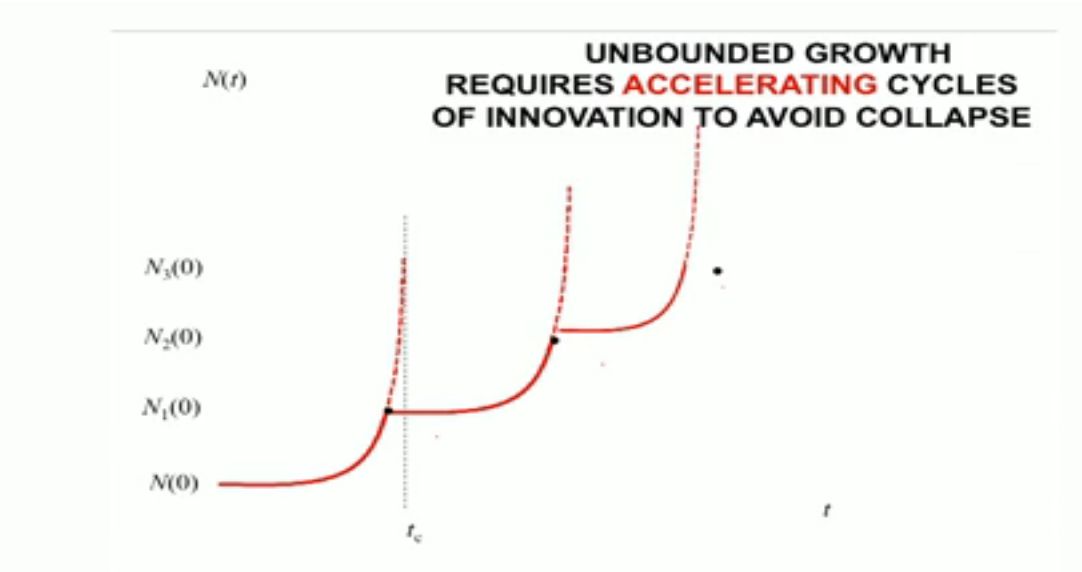
Until (as he does not point out) until the last time when no innovation is waiting in the wings.
Is Zero Waste analysis one of those innovations? For a while, can it so improve the efficiency of resource utilization that it can bail out a collapsing city? Or globe? Not in the face of unbounded population increase, obviously, because nothing can resist that juggernaut, but for a while, maybe.
A review in Science Magazine of a book about dirt and an art display about the book and its subject.
Reviewed by Caroline Ash. The book is called Dirt: The Filthy Reality of Everyday Life. See review in Science Magazine though you may need permissions.
From 2011
The exhibition is part of the Wellcome Collection and showed during August 2011 in London. The book is by Rosie Cox, Rose George, R.H. Horne, Robin Nagle, Elizabeth Pisani, Brian Ralph and Virgina Smith. I only know Rose George who wrote a great book on toilets called The Big Necessity.
The review focuses more on piles of dirt than anything else and includes a picture of a huge mound of dirt behind a brickworks that apparently was formed by the dust plume from the factory. The text suggests that the dust pile was unique enough that it was taken to Moscow in 1848 to assist in the rebuilding of that city. So long as they focus on dirt itself (soil, dust, contaminated water and air) it surely excites and satisfies a unique curiosity. But the reviewer cannot resist passing to more metaphorical interpretations of dirt, such as brothels in Soho and India. And finally to waste in our modern age. Of course this causes him to insert his metaphorical foot in his mouth. He ends like so:
“It is horrifying too, to contemplate the ghastly nightmare of lives on the dustheaps of the world’s megacity slums. With almost 7 billion people on our planet … ultimately there is no place “away” and we must relearn how to value our dirt. This exhibition thus gives us a glimpse into a choice if possible futures: life in a recycled paradise or grim existences eked out on a planetary garbage dump.”
Really? So what exactly does he mean by a recycled paradise? Does he mean a world rationally designed for no discard or does he mean literally a world full of recycling as in the garbage industry definition of smashing and trashing. Undoubtedly the latter. Once again, we are treated to a display of smutty curiosity concerning every aspect of waste, pollution, garbage, dirt and discard except the one which is more important than all the rest – what can we do to improve our world given this new fascination and information? That is the one question that appears to be forbidden in every forum.
Except of course that you can always just dismiss the point with “more recycling”. As though that solved anything, much less everything.
A TED presentation by David Damberbger revealing that his NGO, Engineers Without Borders, has failed badly but they are learning from that failure.
From 2011
While Damberger is describing his NGO’s failure, he visibly breaks down and can barely continue. He wanted to help people so he built them water systems, but he did not plan for the systems to last a hundred years, the way a Zero Waste analysis would, and as a result, he did not build a system, only a product. Without a system, that would have included maintenance, spare parts, modular designs etc. he ended up with a product that broke down in a short time and could not be repaired.
A newspaper article about how the Dept,. of Health manages to scrape together a huge subsidy for California’s biggest chemical dump.
From 2012
Background: Chemical Waste Management owns the biggest chemical dump on the West Coast. It is located in Kettleman Hills California. For decades now, perfectly usable chemicals, recoverable chemicals, often brand new and unused chemicals, have been placed in the ground here and covered over with dirt, just because their owners are too lazy or too ignorant to find any way to reuse them. And they can, because in this country, anyone can insist that any product must be placed into a dump without encountering the specter of reuse.
Recently the poor, mostly Latino residents of the town noticed a cancer cluster forming and complained to the Dept. of Health, hoping, against all the experience of the tight ties between the dumpers and the Dept, that they might get some relief. Fat chance!
The DOH proceeded to exonerate this huge chemical dump in their midst and find no evidence that Chem Waste Mgt. had any liability or causation for the cancers.
But the poor people just would not shut up, like good victims, so the DOH, in the middle of a deep budget crisis in the state, where schools and parks are being closed to save money, somehow found eight million dollars to build the locals a water treatment plant. When politicians have a favorite plan, they never hesitate to come up with the money, no matter how strapped they may claim the budget is.
The local people have been buying water because the drinking water is laced with arsenic and benzene and who knows what else. But the DOH is somehow able to reach out to the Central Valley canal and take enough precious water, which is already pledged, to keep the townspeople quiet. What strings had to be pulled to pull off this miracle?
And as for the eight million? Wouldn’t it be worth eight million for Chem Waste Mgt. to shut up a bunch of whiners that could threaten their beloved dump? We’ll just have to wait for the sequel to learn where the money is coming from.
Subsidies for Big Garbage take many forms. It is rarely that we see an actual payment out in public to keep victims quiet. Most of the subsidies take place behind the scenes, in easy permitting, waivers of the California Environmental Quality Act or in the form of monopolies granted by counties and cities. Or in laws allowing a dumper to totally destroy a large area of the earth’s surface while pretending that he is just like a farmer and will leave a benign park behind when he finishes.
A TED presentation by Bonnie Bassler, a microbiologist discussing how bacterial cells communicate.
She shows the actual chemicals that bacteria use for “quorum sensing”, the technical term for intraspecies cellular communication.
Then she points out in passing that her work suggests that human cells likewise have sophisticated chemical languages so that liver cells know that cardiac cells are different and both recognize spleen cells as having a wholly different home.
This makes me think about industry and commodities and the way they interact in the marketplace. It seems that we are operating on the bacterial level where the only kind of signal is how many of one single product there is but as a Zero Waste designer I am hoping we can progress to the human level hopefully soon, before all the resources run out. We won’t be able to build for perpetual use until all products are designed, built and used in far more sophisticated resource systems than we have today.
A TED presentation by Alberto Cairo outlining the surprising development that he and his Red Cross prosthetics factory went through.
He is not focused on design and yet the unavoidable lesson he draws is how easy it was to redesign the approach they used once they realized they needed to, and how much better the new design was.
He didn’t redesign a product, but a process for producing it and the entire process became more efficient and less wasteful of human labor.
Redesign of production, rather than merely fixing a problem after it is generated, is at the heart of Zero Waste thinking. This is just one example of how much better it is to redesign than to apply a late fix.
Famous chefs take on a challenge to find enough discarded food to feed a hundred people.
Waste and Recycling News (you’re not supposed to notice the irony of combining both in one magazine) report on one more of those challenges that chefs are faced with on TV to make for an interesting show. I guess a million viewers were forced to notice how much discarded but perfectly usable food exists. They point out that most often, food is discarded for fairly spurious reasons, like a blemish on an apple or tomato.
Food is personal. Everyone eats. Everyone can imagine eating some perfectly fine dinner prepared by a chef from discarded food. People are always trying to personalize problems, such as, in this case, unnecessary wasting. But what about the huge waste of industrial processes and the design of products that are intended to fall apart quickly? We don’t eat all these things. We don’t even buy, or ever see all these things. So while viewers, and readers, may wring their hands over wasted food, the much more gigantic waste of EVERYTHING ELSE is mostly ignored. And of course it is ignored in the text of this article since unnecessary wasting is what fuels the profits of the publisher and their favorite industry – Big Garbage!
From 2012
A new design for tall buildings. By Lehman and Crocker
The authors take note that wood can support tall buildings, instead of steel.
The authors in New Zealand suggest that using wood to support large buildings would tie up carbon dioxide in the form of wood and would be helpful for moderating climate change.
A new design concept – building a wooden skyscraper 30 stories high without a steel column in sight. It’s all built out of wood.
The Inhabitat Design Survey displays a skyscraper in Vancouver British Columbia, Canada, that was created by the Michael Green Architectural Group. Presumably computer design allowed for the new strength calculations that make this possible. The wood is not simple unitary beams and columns but glued and compressed formed pieces, much like the laminated beams that have become so popular in halls with large spans. This kind of wood forming is not only very strong but allows the creation of specialized shapes. Laymen often imagine that steel is extremely fire resistant but steel actually loses strength quickly in a fire. Wooden columns carbonize from the outside in, losing strength only late in a fire’s depredation.
The standard view of this kind of building would unthinkingly say that because wood is renewable and sequesters carbon this must be a “green” building (pun intended). Not so fast.
Building any building, no matter what it is made of, uses up tons of resources that have nothing to do with the bare materials of construction. Teams of laborers have to do all of the work as they themselves use up resources for their own and their families’ lives. Factories have to create the specialized parts. Power equipment has to be designed, made and used. There is transportation and fuel for the equipment. And of course the materials themselves require a great deal of time and effort to grow. If the building is designed for its relatively short life, then to be torn down and chipped into glue-laden mulch, then the whole project has been wasted, compared to what could be done.
On the other hand, if the building is designed in modules using standardized connectors and fastenings, then most of the building may have a lifetime in the hundreds of years, even if this one building is disassembled in merely fifty years. Zero Waste design is not satisfied by a naive, conventional emphasis on materials but requires design for reuse. A standard concrete and steel building may be much more conservative of terrestrial resources if it is well designed to be easily dismantled and reused, far into the future. A city full of wood intensive structures that are being routinely torn down and thrown into dumps or even lowgrade sub-applications could become the new forest nightmare.
The price of Zero Waste is eternal vigilance to design for reuse.
Does Nature provide a model for Zero Waste and is it the height of sophistication to copy its models?
From 2012
Elsewhere in these pages I point out that Nature does not provide a good model for us to copy. Human industrial materials and assemblages are not created the way natural organisms are. Fundamentally, nature’s creations are much more complex, they are profligate in their manifold internal designs and they are designed to be completely broken down into the very simplest of materials e.g. carbon dioxide, water, nitrates, sulfates, and reassembled from scratch using sunlight and oxygen for energy. This is exactly what we want to avoid.
Many people who are familiar with the work of Janine Benyus on biomimicry think they have a magical sword by the handle. All they have to do, so their thinking runs, is copy nature in every way and they will be assured of always the best designs. And they use their magic sword on Zero Waste too. Snicker snack goes the sword, copying the reuse mode of nature and breaking assemblages down to basic materials. Such as in recycling in extremis.
In the February 2012 issue of Scientific American (p. 74) we find a human interest interview with Joanna Aizenberg, a chemist doing research at Harvard. Now here is someone with a reverence for nature. She works at the forefront of teasing out the ways that nature achieves her secrets, even on the molecular level. She gives an example of a marine sponge that grows glass fibers in a crown, that look just like those colorful lamps you have probably seen that have a spray of glass fibers that are constantly changing colors at their tips. But the sponge lives in the deep ocean dark and provides a home for bioluminescent bacteria that live in its crown and light up the glass fibers. She has seen it all.
What she has also learned however is to retain humility and not to jump overboard in copying nature. She has this to say:
“Nature can show engineers the vast diversity of solutions for complex technological problems. Not all of them will be practical. One strategy inspired by nature might turn out to be so costly in terms of the materials or the energy needed that we can’t use it. On the other hand some natural solutions might be as good as what engineers do now or a little bit worse but much cheaper. … But we have to be careful. Nature has a very limited selection of materials. Biology doesn’t have steel. We do. So I don’t like to call my field biomimetics because I don’t want to mimic biological structures.”
What are the conventional criteria for choosing a product?
From 2012 (ZDNET email of 4/9)
CNET is in the business of rating products. Here is how they rate a set of earphones.
Best headphones for under $100 (photos)

Looking for an AFFORDABLE pair of headphones that SOUNDS REALLY GOOD for the money? Here are CNET’s top picks.
Price and function – not many people would find anything to complain about in putting these criteria forward. Yet earphones are a tricky buy. The voice coils can easily be burned out, the ear cushions become old and cracked and the cables may tear out of their connectors the first time the earphone is dropped while still plugged in. The device becomes unusable even though it is mostly still all there and still looks like it should work. There are easy ways to make sure that all of these drawbacks are easily repaired so that the whole gestalt continues to operate. Just make use of the usual Zero Waste principles, such as standard design, modularity and standard fastenings. Add breakaway connectors that will come apart rather than tear the wires. Have standard crimp-on or solderable plugs. Use a standard design of ear cushion that is the same as every other set of earphones or that can be refilled with new foam. Things like that. It isn’t even hard. But someone in the design room has to think of it.
An engineer in Australia saves his own life with a device he designs himself.
From 2011
Tal Golesworthy reports on TED how he designed a simple yet sophisticated reinforcement for his own distended aorta using the skills of engineers, designers, investors and doctors in a team. Then he underwent the minimally invasive surgery and extended his own, trouble-free life compared to standard treatments. Over thirty such surgeries have been done to date and all are successful. He reports that the critics can hardly wait for a failure so they can tear down the new treatment in those classic terms – “I told you it wouldn’t work!”
He spends a lot of his time critiquing arrogance, closed mindedness, bureaucratic thinking and stick in the mud experts who refuse to consider anything new. Sound familiar? The designs of Zero Waste run into the same brick walls. “We have dumps, we have recycling, we have incinerators, why do we even need to redesign anything?” So the stilted thinking goes. Tal shows how innovation can yield dramatic results.
The comments following his TED talk are worth reading too.
Recycling: A Free Pass For Wasteful Consumption
2012
This article by Tom Jacobs is a newspaper version of an academic article by Jesse Catlin of UC Irvine and Yitong Wang of Tsinghua University in Beijing, originally in the Journal of Consumer Psychology.
These marketing students decided to give people a task to do that could generate either more or less waste paper. Then they had the task done with and then without a recycling bin in the room. The presence of the recycling potential caused the subjects to make more trash than when the recycling bin was not in the room.
Of course for our readers here, there is not much surprising about the conclusion, but the fact that the correlation could be so easily excited by such a simple experiment is rather amazing.
Read the article
Is your stuff falling apart? Thank Walmart
By Stacy Mitchell
2012
The author shows here that retailers, and especially Walmart, are leading a redesign of manufacturing practices that is 180 degrees opposed to what we urge in these pages. Instead of redesigning for perpetual reuse, Walmart leads the charge for less reuse, fewer resources used, cheaper prices and quick discard into the dump.
She makes the point that we often make here, that design for reuse or early discard controls all future consumer behavior. Once goods are designed to be cheap, non-repairable and shoddy in construction, all in pursuit of low selling price, there is nothing significant that a personal consumer can do. She can’t take it into the workshop and repair it because the parts can’t be replaced or soldered or drilled through or sometimes even disassembled without breaking them. Modern computer aided design allows goods to be designed with the minimum strength needed to get the unit past the purchase and warranty. She doesn’t draw this conclusion explicitly but we can see the dark underbelly of the arguments by those who think that they can drive manufacturing toward sustainability by simply choosing how their money is spent. When Walmart, the world’s largest retailer, designs for low quality and price, it is difficult for other retailers to compete without following Walmart down the dark, fetid alley of extreme price competition. Then the only choices left to consumers are these shoddy goods or those shoddy goods.
It is only a change in the way goods and processes are designed that can have an impact. Is it possible to have a movement for good design that will pledge members to buy decent goods and maintain them forever?
Read article
Do you think you are smarter than anyone possibly could be?
TED talk by Tim Harfor
2012
Tim Harfor is on a mission. He wants people to realize something really obvious – that trial and error is the way that the best complex creations are tweaked and tested until they work best. He points to the human body as an example. Evolution is another word for trial and error.
This talk finds its way here because trial and error is what I have always urged for finding Zero Waste designs. One of the principles in the Principles section is “retain humility”. We can find a first stab at a great new design for perpetual reuse but it will require interrelated designs over many iterations of designs for many products before a really excellent design can be found. That is why I urge putting universities and design schools and research institutes to work on finding the best Zero Waste designs.
To illustrate the complexity arising from the sheer number of products in large assemblages he shows this chart:
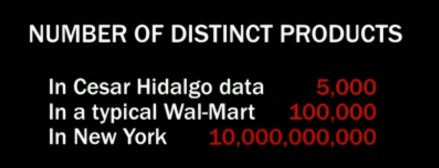
He contrasts some small study of 5000 products and their relationships with an exponential increase in complexity when you look at a Walmart store with one hundred thousand products and then New York City with ten billion products. Substituting Zero Waste design in all of New York City for today’s Total Waste designs will be a major project. But the design for Total Waste was done and so can the design for Zero Waste be done.
Read article
Edible Packaging
NYT Article
2012
The New York Times recently ran one of their pop science articles on innovations that their favorite interviewees would like to see. Predictably most of them were based on space age electronics. But one of them took on the age old problem of packaging. For some reason, mainstream thinking insists that just because some groups made a big stink about packaging a decade ago, that it is an unusual waste problem. Readers of this website realize that solving problems of packaging is, if anything, easier than most wasting problems since packaging has such a simple function – just to contain and protect some contents. But mainstream pundits go ga-ga over the silliest and most meaningless changes in packaging. Maybe it started with McDonough’s Cradle to Cradle book (see my review above) who puffed up packaging that was filled with nutrients so it could be eaten or buried under plants. Here is what the NYT had to report:
It’s depressing to think how much food packaging there is in your kitchen right now — all those juice cartons, water bottles and ice-cream containers. But what if you could eat them? “We’ve got to package in the same way nature does,” says a Harvard bioengineer named David Edwards. And so he has devised a way to convert foods into shell-like containers and films that he calls Wikicells. Yogurt will be encased in a strawberry pouch, for instance. You could wash and eat the packaging, like the skin of an apple, or you could toss it, like the peel of an orange, since it’s biodegradable. The newly wrapped ice cream and yogurt will be available later this month at the lab store in Paris, with juice and tea coming within the next year or two. Nathaniel Penn
Everyone who thinks that this idea will take off and become popular, raise their hands! I thought so! No takers.
This writing incorporates more inappropriate nature worship, always an easy mark for the public seeking quick and responsibility-free solutions.
At the most trivial level, if packaging becomes food, it requires more non-food packaging to keep it clean during shipping and handling. Apple skins are protected in papers and crates and bags. And apple skins are even waxed and waterproof so they shed dirt. Imagine a skin made of strawberry pulp.
As usual, the mainstream idea is to destroy hitherto wasted components more efficiently. Burning packages, grinding and recycling packages, composting packages and now eating them. All destruction! The idea of reusing packages never occurs to these yahoos.
As detailed elsewhere on this website, it is a principle of reuse that when you are going to use a product many times and many years, you can invest in making it robust and full of innovative features and conveniences. When you are going to destroy it after one use, you have to make it as cheap as possible. You can eat it or litter the street but if packaging is going to be discarded it can’t be well made.
Me, you, and everything we eat: Does food righteousness hinder system-wide change?
A Grist Article
2012
In this article, Twilight Greenaway dismisses dismissiveness. She points out that merely making a buying choice that sidesteps a market bad does not raise you above the common herd, to where you no longer have any further responsibility. As the planet sinks into the vanished images of Soylent Green (a movie) a few vegan or other choices have not solved the problem of wasteful consumption, not even if we just focus on food.
In other parts of this website I point out that consumerism is a weak reed indeed to rely on for change, but this author says it so much better.
How do you get people to change their personal preferences?
A TED talk
2012
Jonas Eliasson is a Swedish traffic engineer. He did experiments with congestion that turned out to be serious studies of how people make everyday personal decisions and he finds that by giving people a nudge in a desired direction, they may move without realizing it and if the outcome is good for them, they will embrace the change.
In like manner, I urge changing the way products are designed, in order to nudge people away from waste and garbage discard, rather than using bans and fines and laws and enforcement. People are used to following the natural design of product usage. They bought it, they use it, they will understand it has a different kind of post usage fate.
Listen to his talk
The Fallacy of Cleaning the Gyres of Plastic with a Floating “Ocean Cleanup Array”
April 2013
Stiv Wilson, of EcoWatch in Nation of Change blog
Stiv selects out a single idiotic idea for heated dissection and he does a great job. He focuses on a certain suggestion by someone named Slats that he (Slats) could design 24 floating machines anchored to the ocean floor which would come to the Pacific Gyre and by nibbling at it in industrial sized bites would simply gobble it all up and get rid of it. Why 24? Apparently Slats has no idea. Why anchored to the ocean floor? Apparently Slats has no idea what is involved. Why would this be a solution? Apparently Slats has no idea of what would follow. But do any of these hardheaded, realistic objections slow down the viral spread of this cockamamie idea on the internet? Of course not. Crazy ideas are the only ones that garner that kind of attention. People generally have a few preconditions to their favorite solutions to the world’s problems. First, not too much reality – too boring and too much mental work. Second, it’s got to be personal on some level. Some brilliant entrepreneur or, even better, something they can do in their own personal lives such as by buying a “green” instead of a “black” product. Third, that it must never be an actual solution with hard choices or hard work but must just be a post facto, simple cleanup of some sort. Fourth, it wouldn’t hurt if it reeks of some kind of “high tech” whatever that may mean. Pretend it can all be organized on someone’s smartphone and you’re in like Flynn. And pretend to be thinking “outside of the box”. Stiv Wilson understands this all just perfectly.
From a Zero Waste point of view, there is still a problem however. The Pacific Gyre is not a single problem. It isn’t a huge problem by itself. It’s just one example out of thousands of design flaws for our commercial and industrial society. There is no way to eliminate the Gyre unless you change the commercial assumptions that underpin our wasteful society. It is certainly the opportunity of a lifetime to find a poster child for the need to change the philosophy of abundant waste. By all means we should exploit the emotional attachment to marine cleanliness and species loss that this provides. But we should never forget that there are many more examples that are just as destructive of the planet but not as popular and sexy.
And as for this crazy idea by Slats? Don’t get hung up on it. There is one such notion put out on the internet every few months. Always unscientific and uninformed, without any real design and especially, never any effective solutions. Popular media love them to death. They take some fashionable problem and propose to “clean it up”. The roots of the problem are not explored but are taken for granted. Too much carbon in the air? Fill the atmosphere with a sulfuric acid aerosol. Too much garbage being produced? Fill rocketships to take it to the sun. Or “hydrodepolymerize” it whatever that means. Are beehives dying? Create little robobees on circuit boards that can pollinate flowers instead. Plastic in the ocean? Recycle it all. One thing is for sure though. Next month, there will be another crazy scheme and the pop world will love it.
There is no successful Zero Waste to Landfill (ZWTL) program anywhere in the world.”
April 2013
Robert Krausz’s PhD thesis in New Zealand
Robert Krausz, has pulled off a coup that should rock the recycling world back on its heels. He has shown that all of the ZWTL programs in the entire world are failures. Recycling has been put forward as the magical solution to too much garbage and it has fallen on its face. In one actual trial after another it doesn’t deliver the goods. Robert takes on only four case studies as illustrations – Australia, New Zealand, Toronto and San Francisco but he surveys many more.
Will this stop recycling propaganda in its tracks? Don’t hold your breath. Recycling is a religion that doesn’t depend in any way on actual analysis or success. Those who embrace recycling will go on doing the zombie walk even as their faces and their muscles are falling off their skeletons. You can’t stop their inbred, baseless, unthinking adherence to recycling. But others, who are not recycling zombies, will be shaken a bit and the world will slowly come to its senses. Robert’s thesis is one nail in the coffin of one of the dumbest and most wasteful endeavors that has ever ridden a false assumption around the world.
Read the thesis (340 pages) or Read the abstract
The NY Times reports that specially decorated old buildings in New York are quickly destroyed by developers so no one can claim they are special.
2013
NYT Article: This begins with the ugly non-sequitur, “It’s an ugly job but somebody’s got to do it”. You should recognize this as a puerile attempt to rationalize the inexcusable by objectifying the lousy job you have decided on. It’s no longer your choice, it’s just a necessity. We often encounter the same thing when people try to avoid thinking about garbage by claiming that the only question of importance is “where to throw it”.
Read the article or This version
What I see as a Zero Waste issue, aside from the way that the buildings are designed to be demolished, without high-function, reusable components (see further discussion), involves the decorations themselves. From what can be gleaned from the articles, the decorations are mostly jackhammered into oblivion. Greek friezes and Doric columns become dust in the haste to reduce the buildings to shells. What if the decorations were attached to the buildings by removable fastenings which could easily be undone so that the decorations could be lowered into a truck for transport to new homes. Not only would this make use of high function artistic creations, it might also assuage the sentiments of the feared preservationists that the decorative essence of the building was not going to be destroyed but only moved. However, in this society, preservation must always take a back seat to destruction.
Green Illusions (a book)
by Ozzie Zehner (2012)
Zehner outlines the way in which this country must go if it is to be taken seriously for conserving energy. Today we waste energy as though there could never be limits. Zehner explains in literate prose, broad wanderings and focused detail how important it is to change the context in which energy is used, rather than just shoveling more energy, even if it comes from photovoltaics and windmills, into the endless consumptive maw of the grid.
The book comes in two parts. First, for about five chapters, Zehner disposes of the rosy, unthinking celebration of solar cells, windmills and other alternative energy sources. He explains at length that these are physical objects which will be made in physical factories with all of the difficulties that attach to that fact, as demonstrated also in this website. Since Zehner is focusing exclusively on energy, not on physical production and use, he misses the need for these physical products to be designed according to the principles of Zero Waste. He wrongly takes the wasteful designs of today as an inevitable standard. Yet his criticism of their misleading promise to tamp down fossil fuel consumption remains valid.
Next, Zehner begins to tease out the ways in which alternative energy sources would actually be used in a profligate, energy-wasting, over producing society like the United States. He introduces Jevons Paradox, first enunciated a hundred and fifty years ago, which says that an increase in the efficiency of usage of any resource will be turned around to increase total usage of that resource. At great length, he points out that increases in production of energy, what he calls “productivist” approaches, will simply be added on to existing fossil fuel consumption. He pooh poohs the careless optimism of mainstream environmentalists who just assume that photovoltaics and windmills will somehow reduce carbon dioxide generation.
After completing this analysis, Zehner wins me over with his generous acknowledgement that, in spite of all his analysis, somehow, renewable energy will totally replace all combustion energy. The logic of this statement is simply irrefutable. It does not contradict his analysis however, since future renewables may be quite different from the particular products we look to today and may be far in the future.
Next, Zehner embarks on a prescient and incisive analysis of the much more important changes we could apply today, that would be far more effective in saving energy, and eliminating the need for fossil fuel combustion. These are the many ways in which our way of designing buildings, cities, transportation and interpersonal relations could be rationalized and improved. He draws on his own observations in Amsterdam and a vast literature of superior architecture and city planning.
I might superficially want to criticize Zehner for only seeing energy as a resource and nothing else. But instead, I love his analysis, which, because it deals with reality and not mainstream fantasy, is identical to the one being urged on this Zero Waste website. I hope Zehner is aware that the elimination of energy wasting is simply one sub-element of general Zero Waste theory. Zero Waste refers to everything that is used, all resources, and energy too. Zehner proves that energy fits right into the ZW paradigm.
All one needs to do is to make some simple substitutions of terms to switch interchangeably between Zehner’s analysis and my own. To wit:
| The Energy Example | The Zero Waste Equivalent | |
| Energy | All resources | |
| Energy conservation p. 329 | Resource conservation | |
| Alternative energy sources | Reuse of high function | |
| Oil Companies | Big Garbage companies | |
| Oil Company propaganda p. 317 | Garbage company propaganda | |
| Social redesign p. 184 | Product redesign | |
| Comparing photovoltaics to dirty energy fuels in order to make photovoltaics look good p. 27 | Comparing recycling to dumping to make recycling look good | |
| Simplistic single changes p. 315 | Tweaking products, without changing their contexts of usage | |
| Critique of LEED for its energy profligacy p. 310 | Critique of LEED for its waste of all resources | |
| And as an example of Jevons Paradox where an increase in efficiency generally results in greater total usage | ||
| Alternative energy as a greenwash to increase total energy wasting p. 334 | Recycling as a greenwash to increase resource wasting and destruction | |
The parallel is so complete that even if Zero Waste is to be viewed as a parent, and energy as one child example, Zehner has so masterfully and eloquently analyzed the energy field that he has arrived at virtually every conclusion of ZW analysis within his one sub-element. This is because the profit motive, the growth imperative and unconcern with planetary limitations that drive American Capitalism, apply across the board to dozens or hundreds of forms of enterprise. Health Care, Peace, Nuclear plants, Civil Rights, Climate Change, Education and more all succumb to a similar analysis. It is the only way that American Capitalism knows how to approach problems. Never solve any problem by eliminating the problem behavior at its source but always apply some last minute, technofix add on, an end-of-pipe new management tool that someone can exploit for profit. This one blindness leads to all of the analysis that both Zehner and myself have presented.
Planned Obsolescence – The Waste Makers by Vance Packard
1960
In 1960, cultural critic Vance Packard published The Waste Makers, promoted as an exposé of “the systematic attempt of business to make us wasteful, debt-ridden, permanently discontented individuals”.
Packard divided planned obsolescence into two sub categories: obsolescence of desirability and obsolescence of function. “Obsolescence of desirability”, also called “psychological obsolescence”, referred to marketers’ attempts to wear out a product in the owner’s mind. Packard quoted industrial designer George Nelson, who wrote: “Design… is an attempt to make a contribution through change. When no contribution is made or can be made, the only process available for giving the illusion of change is ‘styling!'”
(Taken from Wikipedia article on planned obsolescence)
Extracted, by Ugo Bardi (a report to the Club of Rome)
2013
Bardi has edited a book with articles about the relentless extraction of the planet’s minerals. He foresees that in 200 years of extraction, we will leave the planet stripped and bare for future citizens.
Read a review
The purpose of this review is to point out a particularly good treatment of rare earth minerals starting on page 226. For essentially the first time I have ever found in literature, Rolf Jakobi recognizes the idiocy of distributing rare elements like indium, gallium and rare earths into millions of devices which are then discarded, carrying the valuable minerals into the void of dumps and other uncontrolled places. What especially intrigued me was that he brought up the notion of modular construction as a way to recapture the minerals, a quite advanced notion out in the mainstream. In fact, this is the only time I have ever seen any writer mention modular construction for its conserving qualities. However, he is limited and hogtied by his unthinking reliance on ideas of recycling. This prevents him from going further and recommending new designs for reuse. Yet in an apparent contradiction, he sees that recovery of valuable minerals will shake up industrial design and revolutionize manufacturing. It’s a start!
The Priest of Abu Ghraib
2019
The Smithsonian Magazine for Jan-Feb 2019 p. 45 reports on a very religious soldier who nevertheless managed to get into the Army as an interrogator at Abu Ghraib, the prison famous for torture of Iraquis.
Joshua Casteel was a victim of American propaganda. Despite his Christian obsessions, he saw the American military as “defending his country” and ended up as an interrogator at an infamous prison, known for torturing prisoners. He treated his prisoners with respect and did better than the torturers at getting information. But he was stationed on an Army base where there was a constant fire for getting rid of military waste. The smoke and smell permeated the base and he was sometimes detailed to feed the fire and inhaled the smoke directly. He didn’t bother with wearing a mask. The fire consumed plastic, metals, paper, explosives, solvents, cleaning compounds and much more. The smoke was horribly toxic. He points out that there were industrial incinerators sitting nearby which could have done a better and cleaner job of burning but it was too much work to use them. Ultimately, he came down with a cancer of the spine that killed him.
At no time does the article comment on the insanity of running a fire for all of the unwanted articles that the military discards, much less stationing it next to the Army’s own soldiers. Josh Casteel is not reported to offer criticism, neither does the author. Waste is normal. Burning it is a good way to get rid of it. They accept this, even at the cost of his life.
Could the military have repositioned its priorities so that reuse of all articles was built into their design? Of course it could have, but it’s unlikely that they would acknowledge that. It’s so much easier to just buy torrents of new goods and burn the used stuff. This waste-blindness has turned the military into the most wasteful institution in the world, and has polluted bases everywhere. Like every institution that is focused on its mission above all, waste is too much trouble to think about, even if it means death for unfortunates.
(Recently military “burn pits” have achieved prominence because President Biden believes that burn pits killed his son Beau.)
The Plastics Recycling Scam
2020
NPR has just come out with a revelation about the recycling of plastics. Memos from decades ago are revealed showing that the industry knew that their sponsorship of recycling for decades was mendacious and would never have any beneficial effect on the torrent of plastics that is now threatening us worldwide. The latest threat comes from microplastics, or tiny particles that shed off of all plastics everywhere and that enter into the air, the water and all food. Then they slip into our bodies where they have unknown effects on our internal organs, not to mention emitting organic pollution that circulates in our blood stream affecting our brain, our hormones, our gut and everything else. But the real point of the video is not to harp on threats. That is being done by articles and revelations everywhere. The unique message of this video has to do with recycling.
1. Recycling is the only response to a glut of plastics that the public is allowed to hear;
2. The plastics industry is responsible for much of the propaganda selling recycling to the public, and;
3. The plastics industry has been lying to the public all along because it knew that recycling would not work as advertised, and;
4. The purpose of the deception was to make money by making and selling ever larger quantities of assorted plastic.
Watch Frontline Plastic Wars, the video
Zero Waste Sewing – a pattern book
by Elizabeth M. Haywood
Zero Waste was first applied to chemicals. Look where it has gone to!
See Book Cover
Here are some pages from the book.
Fashion polis by Dana Thomas
Thomas finds that renting clothing is the most sustainable model, and that feels like a more realistic solution than the futuristic materials she describes at length. In the end I was left wondering: If the fashion industry is this damaging, and none of these developments alone will fix the problem, shouldn’t governments be regulating production beyond enacting stricter pollution standards?
That may be a question for another book; it is not the goal of “Fashionopolis” to provide all the answers. Thomas has succeeded in calling attention to the major problems in the $2.4-trillion-a-year industry, in a way that will engage not only the fashion set but also those interested in economics, human rights and climate policy. Her portraits of the figures who are transforming a field that hasn’t changed all that much in the last century or more sound at once like messages from the future and like nostalgic reveries of life in a smaller, simpler world. If we can combine them, this book suggests, the envisioned “fashionopolis” could transform from an urban nightmare into a shining city on a hill.
Recycling Is a Fraud
Institute for Climate Integrity
From February 2024
This is one chapter heading. It is too delicious not to reproduce here: THE MAJORITY OF PLASTICS CANNOT BE RECYCLED—
THEY NEVER HAVE BEEN AND NEVER WILL BE. Go to the 62 page report and read at least some of it.
NATIVE NATIONS
By Kathleen DuVal
This author writes a series of five books about pre-historical American cities and societies that took place on the land that is modern America. She writes of cities of 10,000 people in the 11th century on the Mississippi. Cities this size were similar to other cities around the world at that time. She tells a story about the toxic accumulation of power in these cities by elites and a general revolution against them in order to eliminate the rise of elites entirely. The small assemblies of people which followed were self-consciously democratic, with a lot of hunting and gathering and some agriculture. She discusses the philosophical attitude that was common in the style of organizing these societies. There was a tribal administration with occasional participation by individuals. She lists three philosophical attitudes that were basic: (1) Don’t be petty (2) Act wisely (3) Think about the future. It is this last attitude which brings this book to my attention, since a fundamental idea of Zero Waste Theory is to design for the future. Contemporary American society adopts an attitude of “let the future take care of itself. Can we make a profit now?” This is why we have so much waste, from goods that are expected to make an immediate profit, with no plan for their eventual post consumer lives.
Listen to an interview with DuVal